
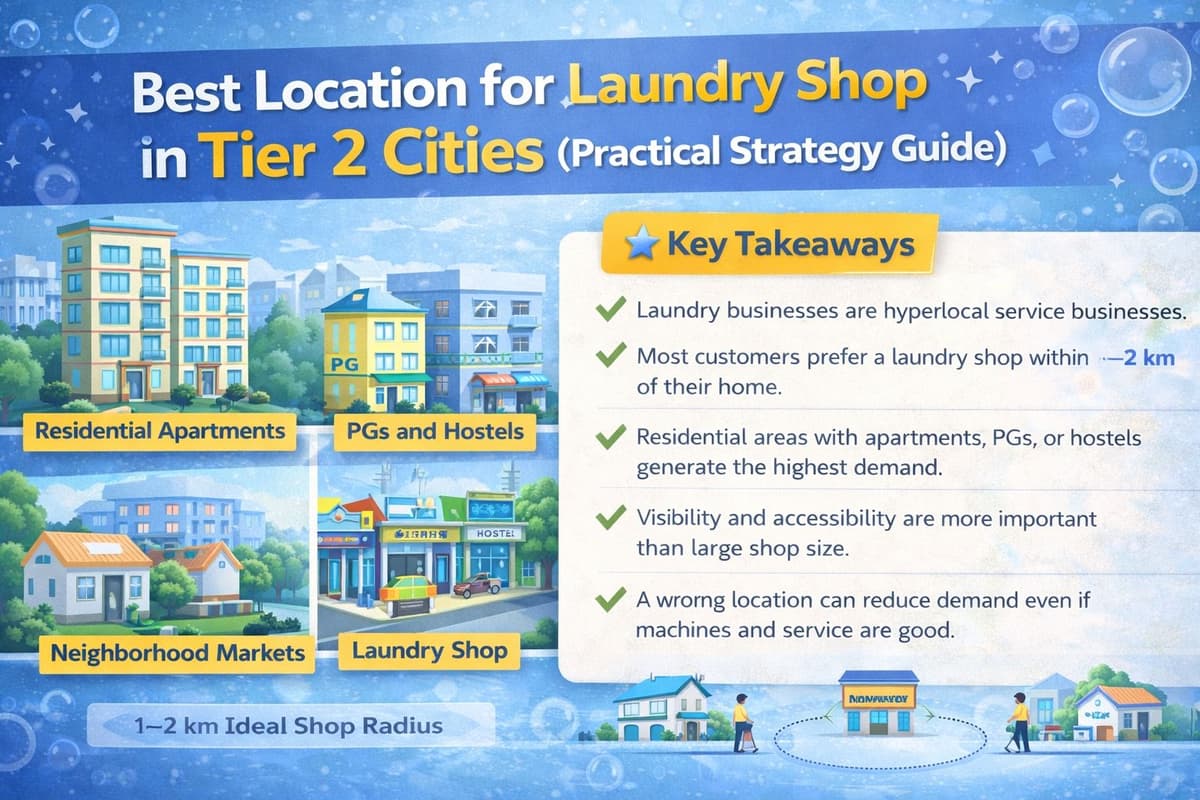
Why Location Matters in a Laundry Business
Unlike many other businesses, a laundry shop does not attract customers from across the city.
Most customers prefer giving clothes to a shop close to their home or daily commute route.
Think about your own behavior for a moment.
If there are two laundry shops offering similar prices, people almost always choose the one closer to their house.
This is why location selection is one of the most important decisions when starting a laundry business.
Even a well-equipped shop can struggle if it is located in the wrong area.
Understanding Laundry Demand in Tier 2 Cities
Laundry demand in Tier 2 cities works slightly differently compared to metro cities.
In many smaller cities:
Families still do basic washing at home
Laundry services are used mainly for heavy clothes, ironing, and dry cleaning
Demand increases in areas with working professionals and students
This means certain locations generate far more demand than others.
For example:
Apartment clusters
PG accommodations
Areas near coaching institutes
Markets surrounded by residential colonies
These zones naturally create a regular flow of laundry customers.
Best Locations to Open a Laundry Shop
Residential Apartment Clusters
Apartment-heavy neighborhoods are one of the best places for laundry businesses.
Residents often include:
Working professionals
Nuclear families
Busy households
These customers are more likely to outsource laundry regularly.
Areas Near PGs and Hostels
Student areas create consistent demand for laundry services.
Students often prefer outsourcing laundry rather than washing clothes themselves.
Hostel zones, coaching hubs, and university areas can become strong customer bases.
Neighborhood Markets Inside Residential Areas
Small markets inside residential colonies often perform surprisingly well.
These markets already attract daily foot traffic for services like:
Grocery stores
Pharmacies
Salons
Tailors
Laundry shops fit naturally into this ecosystem.
Areas to Avoid When Opening a Laundry Business
Some locations may look attractive but don’t generate enough demand.
Examples include:
High-end commercial complexes
Industrial areas
These places often have high rent but limited residential customers.
A safer approach is to prioritise residential demand over commercial visibility.
Distance Rule: Customer Radius in Laundry Business
Laundry businesses operate within a limited service radius.
Most customers prefer a laundry shop within 1–2 km of their home.
Beyond that distance, convenience drops and customers choose a closer option.
This means your shop should ideally be located inside or near dense residential clusters.
Simple Checklist to Evaluate a Shop Location
Before finalising a shop, ask these questions:
Are there at least 5–10 residential buildings nearby?
Are there PGs, hostels, or student housing nearby?
Is the shop visible from the road?
Is quick parking or stopping possible for customers?
Are there already laundry shops within 500 meters?
If most answers are positive, the location is likely workable.
Common Location Selection Mistakes
Many beginners make predictable mistakes while selecting shop locations.
Choosing a Shop Only Because of Low Rent
Cheap rent sometimes means the area lacks demand.
Hidden Shop Locations
Shops in basements or hidden lanes reduce visibility.
Laundry businesses depend heavily on convenience and walk-in traffic.
Customers should easily notice the shop while passing by.
FAQs
What is the best location for a laundry shop?
Residential areas with apartments, PGs, and hostels usually generate the highest demand.
Can a laundry shop work in a small market area?
Yes. Neighborhood markets inside residential colonies often perform very well.
Should I open a laundry shop in a commercial complex?
It depends on residential density nearby. Purely commercial complexes may have limited demand.
How far do customers travel for laundry services?
Most customers prefer laundry shops within 1–2 km of their home.
Final Thoughts
Choosing the right location is often the difference between a struggling laundry shop and a successful one.
Machines, pricing, and marketing all matter — but if the shop is located where customers naturally live and move, the business becomes much easier to grow.
For many laundry entrepreneurs in Tier 2 cities, the best locations are surprisingly simple:
Small neighborhood markets surrounded by residential buildings.
That’s where convenience meets demand.
Ready to turn this into a business?
Learn the machines, chemicals, operations and pricing behind a successful laundry business, or verify a completed course, with GILM.